
2025 was a great year for high quality software engineering content. I particularly enjoyed the Wookash Podcast, where the host, Łukasz, interviews many prominent and successful developers—my favourites include Billy Basso (of Animal Well fame) and Iñigo Quilez, graphics programming legend and co-creator of Shadertoy.
The episode with Stewart Lynch introduced me to 10x Editor, a tool which has significantly improved my productivity and enjoyment programming. There’s also an episode with Ryan Fleury, who is working on Rad Debugger—yet another tool that has meaningfully improved my quality of life and love of programming.
2025 also marked the inaugural Better Software Conference, which was brimming with fantastic talks. Highlights for me include Parallelizing the Physics Solver by Dennis Gustafsson and Programming Vehicles in Games by Wassim Alhajomar.
So much fantastic (and free) content! A great movement, people writing code to utilize the underlying hardware in a sensible way. Streamlining how data is loaded, transformed, stored, and presented. Using less power, preventing wear and tear on the hardware. Respecting the user! Nothing but low latency, performant, functional software.
A truly wonderful contrast against the tsunami of AI slop and snake oil salesmen.
Across all of these talks and interviews, one name is mentioned frequently: Casey Muratori. Specifically, many of the younger generation of programmers credit their career trajectory, method of software development, and love for the craft to Handmade Hero.
Handmade Hero was a series of streams where Casey live developed a video game from scratch – using no external libraries. Just C(++) and the Windows API (later OpenGL to interface with graphics cards, but not before writing a software renderer).
I never really followed the series back then, but I’ve considered it many times. Well, 2026 is the year.
Week 0: Intro to C
I’ve already watched Week 0: Intro to C. It is so much more than an introduction to C. Sure, it covers functions (prototypes, parameters, return types), scopes, data types, if-statements, switch statements, arithmetic operators, bitwise operators, logical operators. But, it also covers Virtual Memory Address Space, the Stack, Registers, Instructions, Memory (latency, throughput, endianness), CPU Die (cores, cache, I-cache).
Everything is demonstrated practically in the debugger. Casey even shows how to read disassembly and navigate to the memory of executing instructions. In other words, he really shows how the program runs on the hardware.
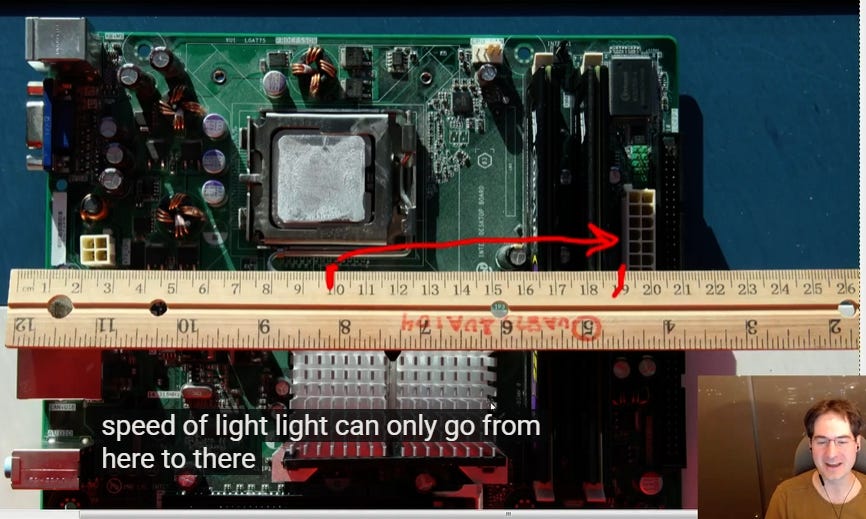
In episode 3, Casey presents a photo with a ruler measuring the distance between the CPU and physical memory on a motherboard.
He does the math live:
Demonstrating you can only just barely reach the memory in the time it takes to do one instruction on the CPU, let alone return. This reminded me of Andrew Kelley’s talk—A Practical Guide to Applying Data Oriented Design (DoD). And of course, the famous Mike Acton talk.
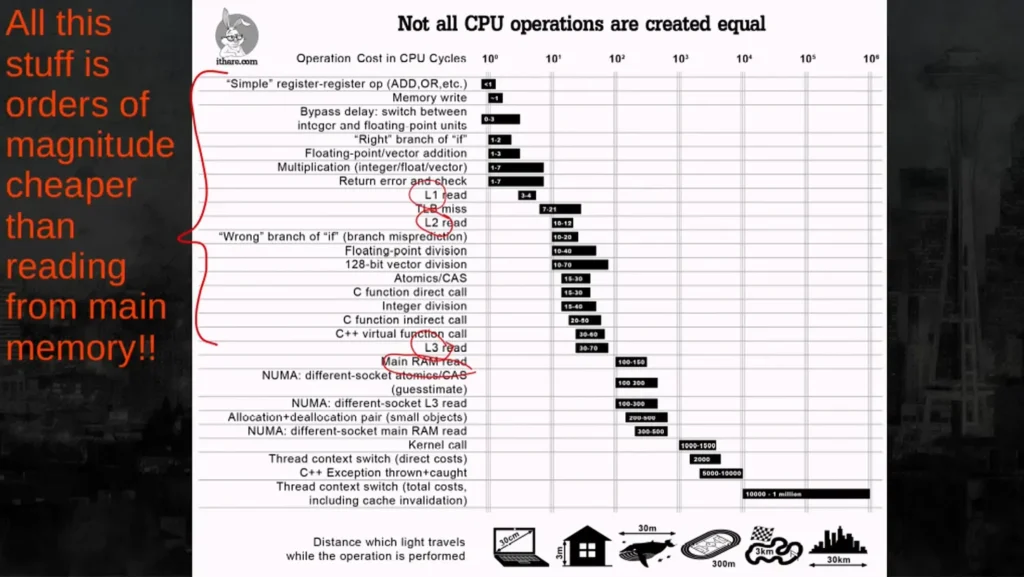
I didn’t even begin to learn about this way of thinking (data oriented design) until I was working at THQ (somewhere between 2008 and 2011). I lucked out and had Tony Albrecht for a colleague, who gave us a similar talk Pitfalls of Object Oriented Programming.
Casey is talking about this in Week 0: Intro to C. This really is the right way to teach programming. It’s not surprising that Handmade Hero graduates turn out to be superstars.
Reinventing the Wheel
During the Q&A after Episode 1 of hte official stream, Casey is asked the following question:
Why start from scratch versus using an engine? Why reinvent the wheel?
You can watch part of Casey’s response here. I’m going to paraphrase for completeness of this text:
We don’t have a wheel, but people need to have knowledge of how to do low level programming so we have more people attempting to make a wheel.
It feels like all these years later, Casey’s efforts are really paying off. We are starting to see some wheels entering late stages of development from Handmade Hero graduates.
- Rad Debugger by Ryan Fleury, replacing the now bloated and slow Visual Studio Debugger. During the introductory week of Handmade Hero, Casey expresses frustrations several times that he can’t view memory in binary in the Visual Studio Debugger. Well, you can now in Rad Debugger—just use the
bin()view. - File Pilot by Vjekoslav Krajačić replacing the native windows explorer as a snappy file browser with intuitive shortcuts and powerful search
- Odin Programming Language by Ginger Bill as an alternative systems level programming language to C++
- Whitebox by Andrew Reece, a visual debugging tool for programmers
Ginger Bill summed this up nicely in the intro to his BSC talk. Like him, and as a user of many of these tools, I am very glad Casey inspired others to care deeply about the craft.